Saturday, January 18, 2014

A disaster in the making: 95% of ATMs still run Windows XP

A disaster in the making: 95% of ATMs still run Windows XP


Microsoft Windows XP ATMs


As we’ve mentioned multiple times, now is really the time to upgrade from Windows XP if you haven’t done so already. Even though Microsoft will extend support for its Windows XP security products through July 2015, the company has warned that “the effectiveness of antimalware solutions on out-of-support operating systems is limited.” Bloomberg Businessweek reports that some of the most important machines that desperately need to upgrade from Windows XP are ATMs, of which an estimated 95% still run on Microsoft’s older operating system.

There’s some good news and bad news about this. On the plus side, Bloomberg Businessweek says that the more advanced fleets of ATMs should be able to upgrade their machines to a newer version of Windows through their network. Older ATMs, however, will still have to have a new version of Windows installed one by one, which means that technicians will be making lots of trips to different convenience stores this spring to make sure upgrades are going as planned.

“My bank operates an ATM that looks like it must be 20 years old, and there’s no way that it can support Windows 7,” Suzanne Cluckey, the editor of trade publication ATM Marketplace, tells Bloomberg Businessweek. “A lot of ATMs will have to either have their components upgraded or be discarded altogether and sold into the aftermarket—or just junked.”


Taliban Calls Kabul Cafe Attack Retaliation for a Strike That Killed Civilians

Taliban Calls Kabul Cafe Attack Retaliation for a Strike That Killed Civilians


KABUL, Afghanistan — The Taliban claimed responsibility on Saturday for an attack the day before on a popular Kabul cafe that killed 21 people, mostly Western civilians, saying it was in retaliation for a coalition airstrike on Wednesday in which a number of Afghan civilians had died in a village north of Kabul.
In their statement, the Taliban said they picked a restaurant frequented by “high-ranking foreigners” where alcohol was served. The attack, one of the most significant on Western civilians since the start of the war in 2001, struck at the heart of one of Kabul’s most secure districts, very close to many embassies and coalition military bases.
Western officials questioned the Taliban’s stated motive for the coordinated attack, which occurred just two days after the airstrike and would have required extensive planning. A suicide bomber cleared a path for two gunmen who stormed in and fired on diners, the police said.
The dead included the representative of the International Monetary Fund in Afghanistan, the United Nations’ senior political affairs officer here and a British Labour Party candidate for the European Parliament who had been working in Afghanistan. Two Americans working at the American University in Afghanistan were also killed in the attack, the university said in a statement on Saturday. 


“The attack was in retaliation to the massacre carried out by foreign invaders two days earlier in Parwan Province’s Siyah Gerd district, where the enemy airstrikes destroyed up to 10 homes, razed several orchards as well as killing and wounding up to 30 innocent civilians, mostly defenseless women and children,” the Taliban statement said.
The international coalition, the United Nations, diplomats and Afghans quickly offered condolences and condemnations over both attacks. Later, President Hamid Karzai, whose relationship with the Americans has been strained in recent months by negotiations over a long-term security contract, expressed sympathy for the victims of the cafe attack but also seemed to use the airstrike to criticize his NATO allies over the issue of civilian casualties.
“The war on terror will bear fruit when victims and terrorists are distinguished from each other and the elements of terror are fought against,” said Mr. Karzai, who appointed a committee to investigate the civilian casualties from the airstrike. “If NATO, led by the United States, wants to be the Afghan people’s ally, they should target terrorism.”
An American military official said that the airstrike had been called in by Afghan and American forces who were under fire from Taliban fighters. “The operation was requested by the Afghans and approved by the Afghans,” the official said.
“More than 80 percent of Afghan civilian casualties are caused — in most cases intentionally — by Taliban, Haqqani and other terrorist and insurgent groups,” the official added.
The Ministry of the Interior, which oversees the Afghan police, suspended the commander and intelligence officer in charge of the district where the restaurant is and placed them under investigation.
Kabul appeared to return to normal on Saturday, with a slightly heavier police presence visible along its traffic-choked streets, especially near where the cafe attack occurred. While bombings are not uncommon in Kabul, the extent of the damage and the targeting of Western civilians raised alarms.
Some international organizations tightened security, clamping down on the modest freedom of movement enjoyed by foreigners working in Kabul. United Nations officials, meeting privately, vowed not to adopt a “bunker mentality” in response to the attacks, which claimed the lives of four of its personnel, including two from the United Nations Children’s Fund.


Apparently the only people who escaped the cafe attack were local employees of the restaurant, some of whom jumped off the roof of the building and into a neighbor’s yard.


The chief political affairs officer for the United Nations in Afghanistan, Vadim Nazarov, a longtime official with the agency, was killed in the attack, according to two people who spoke on the condition of anonymity because the information had not yet been made public. Mr. Nazarov, a Russian, was highly regarded for his years spent here and his understanding of Afghan politics.
The International Monetary Fund said its representative in Afghanistan, Wabel Abdallah, was also among those killed. Mr. Abdallah, 60, had served here since 2008 and had managed to forge a good working relationship with Afghan officials despite a series of scandals that left many Western officials at odds with their Afghan counterparts.
The Taliban also claimed to have killed a high-ranking German official, but the German Foreign Ministry in Berlin, reached Saturday, said it could not yet confirm that report.
Senior officials at the American University in Afghanistan reviewed security procedures on Saturday, but decided to proceed with scheduled student orientation and academic activities.
“That’s how our colleagues would have wanted it,” said Timor Saffary, the school’s chief academic officer.
One American killed in the attack had recently joined the political science faculty at the university, while the other worked in student affairs, according to the university’s statement.
The attack on the lightly guarded restaurant was a departure for the Taliban, who have historically singled out heavily fortified government compounds and high-profile symbols of the Western presence in Afghanistan, like the American Embassy and a building believed to house the Central Intelligence Agency station in Kabul.
Those attacks, while generating news media attention, have often been far less successful in generating heavy casualties. Typically, Afghan civilians who happen to be in the vicinity are the victims. A Taliban bombing this month at the entrance to Camp Eggers, a large base for the American-led military coalition in the center of Kabul, did not inflict any casualties, for instance. The base is less than a mile from the restaurant that was attacked.
The restaurant, which serves Lebanese food and has a clientele made up largely of expatriates, had almost none of the security measures employed by official installations, like concrete blast walls or checkpoints. It is also one of the few establishments in the city that has been approved by a number of international agencies.


Google goes after your eyes (but this time, not with ads)

Google goes after your eyes (but this time, not with ads)


Google Smart Contact Lens Diabetes


Google on Thursday unveiled a new Google X moon shot project that’s supposed to help patients diagnosed with diabetes better measure and manage blood sugar levels – a smart contact lens that can test tears and alert the wearer, potentially with help of a LED light. The contact lens, which still has many obstacles to overcome until it becomes a product available to potential buyers, packs “chips and sensors so small they look like bits of glitter, and an antenna thinner than a human hair.”

At this time, it’s not clear how the lens will connect to other smart devices such as smartphones and tablets to transmit recorded data, or whether this will indeed be a feature. According to Re/code, Google isn’t interested in connecting the lens to Google Glass, at least for now, and the smart contact lens project is separate from the Google Glass product. Even so, Glass project founder Babak Parviz also advises the contact lens team.

Google doesn’t want to manufacture and sell the product by itself though. Instead, it’s looking for partners to help in this endeavor. At the same time, the company is also talking to the FDA about it – in December when the two parties met, it was speculated that Google wanted to talk about Google Glass with the regulator.

google-smart-contact-lens-2

Before the smart contact lens becomes official, Google will also have to determine whether measuring tear fluid is actually relevant for blood sugar levels. The company is working with the Diabetes Research Institute at Mills-Peninsula Health Services on a clinical study on the matter. Dr. David Klonoff, medical directory of the institute, told the publication the data he seen so far is “optimistic,” although no results have been officially reported.

In addition to Google, other companies are trying to determine glucose levels in diabetes patients by using different means than the traditional daily blood drop tests, including testing saliva and exhaled breath or using infrared light on the earlobe. However, neither technique has received FDA approval yet, therefore such products aren’t available commercially.

With 380 million people worldwide diagnosed with diabetes — and with that number expected to top 590 million by 2035 — Google’s smart contact lens is certainly an interesting idea. Let’s just hope future users won’t have to sign into Google+ to receive blood sugar reports.


Friday, January 17, 2014

Guess which wireless carrier has the biggest bills in America

Guess which wireless carrier has the biggest bills in America 
Most Expensive Cell Phone Service


Most Expensive Cell Phone Service

Consumers and businesses in America spend billions on wireless service each year. And it’s no wonder — the average cost of cell phone service on each of the top four nationwide carriers in the U.S. is painfully high. One is higher than the rest, of course, and you’ll have to try to act surprised when you find out which it is.

According to a study conducted recently by Cowen and Company and picked up by Ars Technica, Verizon Wireless customers pay more for wireless service each month on average than any other customers in the country. Verizon is widely known as the most expensive carrier in America though, and many of its subscribers have come to accept the high cost of service in exchange for fast LTE data and outstanding coverage in most areas across the country.

Verizon CEO Lowell McAdam has also made it clear on numerous occasions that Verizon has no intention of competing on price.

Cowen’s Q4 study surveyed 1,876 wireless subscribers in the U.S. and found that Verizon bills averaged $148 per month including taxes and fees. Sprint has the second most expensive service at $144 on average, followed by AT&T at $141. Not surprisingly, T-Mobile has the cheapest service on average at $120 per month.

A similar study performed by Cowen in the third quarter last year yielded comparable results. Verizon was the most expensive at $153 per month, T-Mobile was the cheapest at $133, and AT&T and Sprint were in the middle at $147 and $143, respectively.

BGR covered another aspect of the firm’s newest study earlier this week. According to Cowen’s research, Verizon subscribers are not the most eager to switch to a different carrier despite paying the most for service each month. That unfortunate title goes Sprint, while AT&T customers appear to be the most satisfied with their service.


7 Things You Need to Know About Costco

7 Things You Need to Know About Costco


Many people shop at Costco because they want good value on the more than 3,700 items in stock. Yet few people know just how Costco is able to give its customers such quality and value, or what makes Costco different from other wholesale companies. We spoke with regular Costco shoppers -- or members, as the company calls them -- as well as with Costco executives and retail analysts to get the inside story on what attracts 72 million Costco members and $103 billion in sales per year.
Here are seven things you should know about the warehouse store:
If you want brand names for less, you'll find them here. Costco is a source for brand-name merchandise but the store doesn't tell you which designer brands they carry because brands vary and the designers don't want that information revealed. "We sell high-end items at a great value or at a great price," says Jeff Elliott, assistant vice president, finance and investor relations for Costco. "We're not a fashion retailer. We're a general merchandise retailer, generally basics. It could be the latest merchandise but we're in the basics business." Apparel is a risky category, he adds, so fashion is not Costco's focus. That doesn't mean you can't find better brands of winter boots, for example, or leather jackets.
When you go abroad, you can still shop. Costco warehouses are located in the U.S., Canada, Mexico, the U.K., Korea, Japan, Taiwan and Australia. The company plans to open in Spain in the spring of 2014. Merchandise varies regionally. "We have buying offices in each region," Elliott says. For example, if there is a salsa manufacturer in a particular place, Costco aims to carry that item for that region, he says.
Quality at the lowest possible price means value. Costco aims to sell quality merchandise at the lowest possible price, and "we call that value," Elliott says. "The way we do that is we buy in bulk and keep overhead low." In the marketplace, food items, for example, are typically marked up 20 to 30 percent, Elliott explains. "On average, our typical markup is 10 percent." The way Costco marks up less than others is because they have lower overhead using the warehouse model to sell their goods from the shipping pallets rather than unloading items, opening boxes and stacking items on shelves. "We drop a pallet on the floor," Elliott says, and it's typically a concrete floor. "The whole concept is based on volume. The more volume we can do the more we can save our customers."
If you buy an item by mistake, you can bring it back for a cash refund. Costco ranks number one among stores with the best return policies, according to the website, gobankingrates.com, which ranked stores in December 2013 for return policies just after the holidays. Second was Nordstrom and third was Zappos. Costco member Joan Silver of Fairfax, Va., described how she was able to return a case of yogurt to Costco within days of purchasing it because it was not the kind she had intended to buy. She said she also has returned jeans that didn't wear well.
"We know who you are if you're a member of Costco," Elliott says. If Costco has a recall on any of its merchandise, someone from the store can call customers who purchased the item. "We can just look it up," he says. Refunds are made in cash or back to the customer's American Express credit card, which is the only type of credit card that Costco accepts. (It also accept cash, checks and debit cards.). "Whatever the customer wants is what we want to do," Elliott says.
[See: 13 Money Tips for Married Couples.]
Kirkland is made for Costco. Twenty percent of all the items in a Costco warehouse are sold under the name Kirkland. All kinds of manufacturers make these products for Costco. Kirkland items range from two loaves of bread separately packaged and then packaged together in a plastic bag to a package of three pounds of raw almonds.
Food is key. "Food is your traffic driver," Elliott says. Typically, shoppers head to Costco for basic food items, then walk by the apparel area, and see a designer brand shirt for $29.99 that sells in other stores for $59.99, or they browse in electronics and find a TV that usually costs $2,400 for $1,900. From fresh and packaged foods, sundries, electronics, sporting goods, hardware and automobiles to apparel, luggage, housewares, linens, and travel, Costco sells most product lines including items like high-end jewelry, men's suits and cosmetics.
[See: The 10 Most Dangerous Products to Kids.]
Hot dog and soda is a winning combination. Costco sells 109 million hot dog and soda pop combinations worldwide per year at $1.50 for the combination of the two items. The details: Each hot dog is more than 1/4 pound and the hot dog and soda pop combination have been sold in all Costco locations since its founding in 1983.
The 72 million members of Costco attest to the popularity of the international wholesale store. Whatever you need, Costco aims to have it at good value - quality at the lowest price. Sometimes they carry special items for a certain period of time. "It creates what we call the treasure hunt," Elliott says.


Google working on yet another way for apps to track you

Google working on yet another way for apps to track you


Google Android Fitness API


Don’t be surprised to see future mobile apps ask your permission to track your vital signs. Google Operating System has spotted some code for a new Android Fitness API that will let Android apps “view and edit your fitness tracking, health and activities data, including reading and writing raw and transformed data.” Google Operating System speculates that Google will likely store data from multiple apps in your Google account so you can get a complete picture of your daily well being. Given the coming importance of wearable computers, it seems likely that Google has created this API in preparation for Android-based smartwatches and fitness trackers that are set to launch this year.


Plant of the Week: Haemanthus - the Blood Lily

 Tara Heibel Tara Heibel  GET UPDATES FROM Tara Heibel   Like 12 Plant of the Week: Haemanthus - the Blood Lily 


The blood lily, or Haemanthus, is a flowering plant in the family Amaryllidaceae naturally found mostly in regions of southern Africa receiving winter rainfall. Three of the genus' species, albiflos, deformis and pauculifolius, are evergreen and normally found in summer rainfall regions with their bulbs planted partially buried so that the nubs poke up above the soil, whereas the winter rainfall region has more arid blood lilies in which bulbs are found well below the soil line, often pushing their flowers out before the leaves make an appearance. Haemanthus albiflos is the only species to span both rainfall regions.
Even though there is a broad range of species in this family in regards to looks and care the flower of this genus has a textural commonality that is hard to miss. Flower color can range from red to white and resembles some aspect of a bottle brushes poking up above the soil. The genus' common name of blood lily was given to it because of the coccineus and sanguineus species whose flower color is blood red. While one of my favorite species as an indoor houseplant, the H. albiflos, flowers white. The leaves can also greatly vary from species to species from number to shape and form. Another reason why the Haemanthus albiflos is preferred as a houseplant by many is because its leaves are as interesting as its bloom, boasting thick, ovate, rubbery leaves that explode from the base. Leaves are soft and matte on one side while the other side is slightly furry and soft. The blood lily will also fruit after flowering from shades of red to white. These fruits can be utilized for propagation besides using offsets or leaf cuttings. Keep in mind their seeds are not like conventional dried seeds and need to be propagated immediately if selecting that method.
Blood lilies have a wide variety of light requirements depending on the species. Full sun blood lilies are normally experience winter rainfall, and are deciduous species while ones that crave partial shade are generally expect summer rainfall and are evergreen species. Blood lilies need well drained soil and can be tolerant of poor soil. Do not try to repot or disturb them when they are in the middle of a bloom cycle. The Haemanthus albiflos is one of the most widely cultivated blood lilies and the one that I recommend trying as a houseplant if you want to add this genus to your plant repertoire. It is evergreen -- keeping its thick leaves all year round, blooms regularly November through January, only needs partial shade versus full sun and will bloom in its third or fourth year where some species can take over a decade. Don't let the namesake drain you...
leonora enking

niranjan patil


Thursday, January 16, 2014

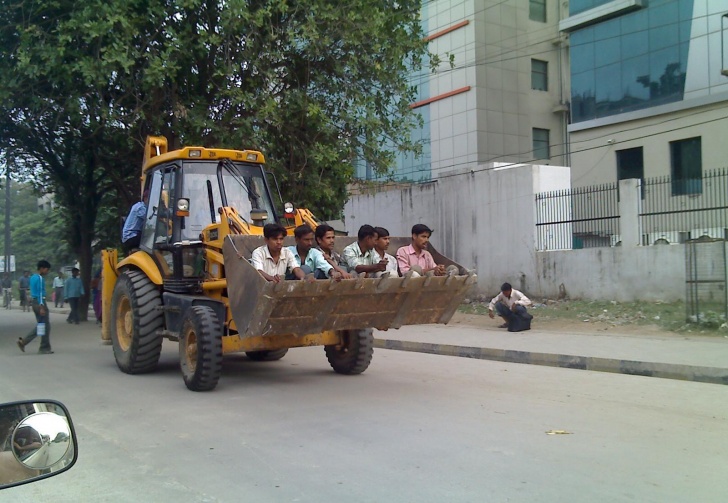
10 MOST FUNNY PUBLIC AND PERSONAL TRANSPORT PICS


#10 – A Multi-Purpose Vehicle


#9 – Who's Driving at Me?


#8 – Perfect Logistics


#7 – Whole Family


#6 – What da Duck?


#5 – Funny Dudes


#4 – Conspirator at Work


#3 – Free Ride


#2 – A Perfect Mix


#1 – African Style